Skip to content
Kia Ndutu: The Heartbeat of the Great Migration – Calving, Predators, and the Untamed Serengeti
When travelers dream of the Serengeti, they imagine endless horizons, acacia trees silhouetted against a setting sun, and the thunderous hooves of a million hooves shaking the earth. But there is a specific place, a sacred corner of this vast ecosystem, where the savannah tells its most intimate and violent story. That place is Kia Ndutu.
Nestled in the Ngorongoro Conservation Area, bordering the southern plains of Serengeti National Park, Ndutu is not just a location on a map; it is the epicenter of life itself. While the rest of the world knows the Serengeti for the river crossings of the Mara, those who truly understand the wild know that the soul of the Great Migration resides here, on the short-grass plains of Ndutu, from December to April.
What and Where is Kia Ndutu?
To understand Ndutu, you must first forget the image of dense bushland. The Southeastern Serengeti plains, which cradle Lake Ndutu and Lake Masek, are a study in minimalism. The soil is volcanic, originating from the ancient eruptions of Ol Doinyo Lengai. This ash has hardened over millennia to create a substrate that is too hard for tree roots to penetrate.
The Landscape:
The result is a surreal, almost Martian landscape of short, nutrient-rich grasses that stretch to a curvature horizon. Unlike the wooded Seronera or the riverine forests of the Western Corridor, Ndutu is open. This openness is the key to its biological importance. The grass here contains a calcium-to-phosphorus ratio that is scientifically perfect for mammalian lactation.
Why “Kia Ndutu”?
The term “Kia” often denotes a region or area in local context. The area is dominated by Lake Ndutu, a seasonal, alkaline lake. During the dry season, it shrinks, leaving salty white crusts. During the green season (the calving period), it swells into a shimmering blue oasis, attracting flamingos, pelicans, and the massive herds of wildebeest.
Because the area sits in the Ngorongoro Conservation Area (rather than strictly inside the National Park), there is a unique rule that changes the safari experience entirely: Off-road driving is permitted. This regulation transforms a Ndutu safari from a passive observation into an interactive pursuit, allowing vehicles to follow cheetahs mid-chase or sit quietly within meters of a laboring wildebeest mother.
The Great Migration: The Race of Life
The Great Migration is a circular pilgrimage of 1.5 million wildebeest, 300,000 zebra, and hundreds of thousands of gazelles. The popular narrative focuses on the dramatic drownings in the Mara River (July–October). But the biological purpose of the entire journey happens in Ndutu.
The Rut:
Before they arrive in the south, the wildebeest go through the rut (mating season) in the woodlands of the Northern Serengeti. But nature is precise. The gestation period of a wildebeest is roughly 8.5 months. By mating in the north, the wildebeest have timed their arrival in the south to coincide with the fresh green grass of the rains.
The Birth Wave:
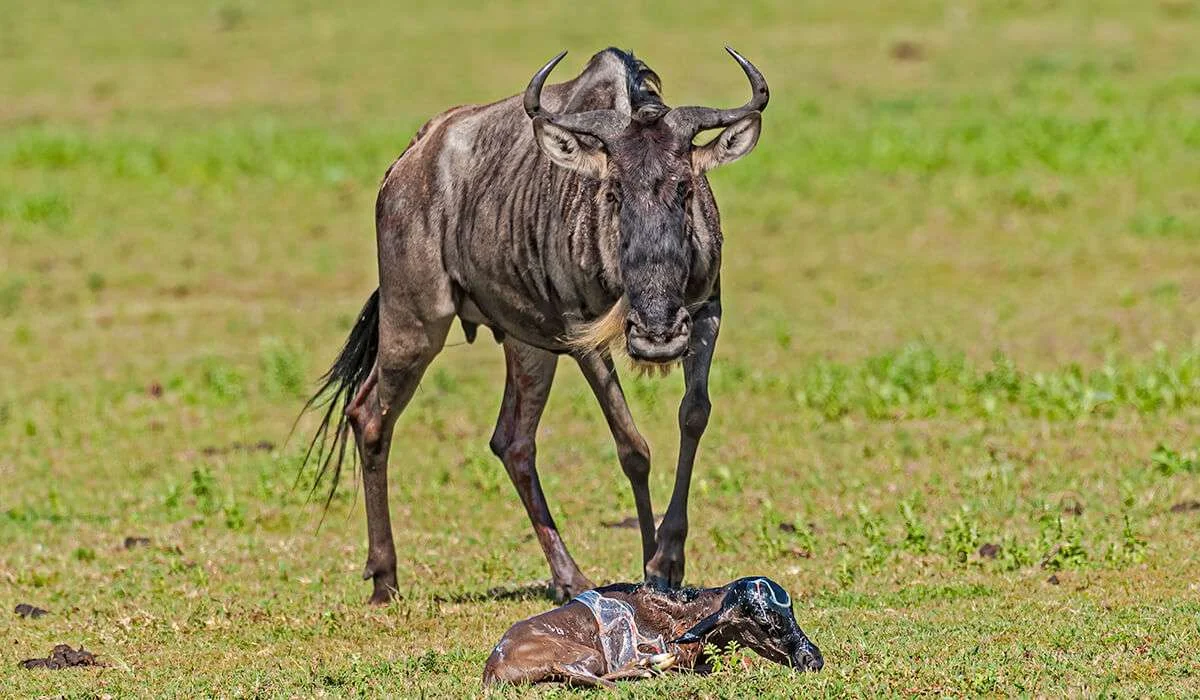
Between late January and February, the plains of Ndutu host the most concentrated event of mammalian birth on the planet. In a typical year, over 8,000 calves are born EVERY DAY.
This is not a coincidence. It is a survival strategy known as “predator satiation.” The herds are so vast, and the births so simultaneous, that predators (lions, hyenas, cheetahs, leopards) cannot possibly eat them all. While a cheetah is focused on one clumsy newborn, 500 others are taking their first steps to the north.
The First Ten Minutes:
Witnessing a wildebeest birth is a religious experience for safari-goers. The mother separates from the herd. She lies down, and within minutes, the front hooves emerge. The calf drops onto the grass. Here is the miracle: within three to five minutes, the calf is wobbling to its feet. Within ten minutes, it is running alongside its mother.
They are born with a “signature” smell. The mother and calf will spend the next 24 hours in a chaotic nursery, touching noses and memorizing each other’s unique bleat and scent. If they lose each other in the chaos, the calf will die it cannot suckle from another mother.
The Predator Capital of Africa
If there is a heaven for predators, it is Kia Ndutu. The short grass offers no cover for prey. The sheer density of vulnerable newborns turns the savannah into a buffet. During this season, Ndutu arguably offers the most reliable big cat viewing on the continent.
The Lions of Ndutu
The lion prides of the southern plains are massive, often numbering 15-20 individuals. Because the grass is short, they cannot stalk traditionally. Instead, they adapt. You will see lions using the small rocky outcrops (kopjes) as observation posts. A lioness lying on a rock, surveying the endless sea of wildebeest, is the quintessential Ndutu image.
Behavior to watch: Lions attempting to hunt during daylight because the herds are too dense to wait for night.
The Cheetahs: The Speedsters
The open plains are the cheetah’s ideal hunting ground. Ndutu has one of the highest densities of cheetah in Africa. Unlike lions, cheetahs rely on speed, not stealth. You will often see a mother cheetah positioning her cubs in a specific spot, then walking directly toward a herd of gazelle or wildebeest, not hiding, simply gauging the distance.
The Strategy: The cheetah will single out a wobbly, slow calf. The chase is explosive 0 to 100km/h in three seconds. In Ndutu, the short grass means you see the entire chase, not just the dust cloud.
The Hyena Clans
Spotted hyenas are the misunderstood villains of the plains. In Ndutu, they are the tactical geniuses. Hyenas do not just scavenge; they are responsible for the majority of wildebeest calf kills. They hunt in clans, using endurance to separate mothers from calves. The sound of whooping hyenas at dusk, echoing across Lake Ndutu, is the soundtrack of the wild.
The “Kia” Factor: The Secretary Bird
Beyond the big cats, Ndutu is one of the best places to see the Secretary Bird. This terrestrial bird of prey, with its long eagle-like legs and quill-like crest, stalks the plains on foot, stomping on snakes and insects. Seeing a Secretary Bird stomp a venomous snake in the short grass of Kia Ndutu is a bucket-list moment for birders.
The Logistics: Planning Your Kia Ndutu Safari
Unlike the northern Serengeti, which requires grueling drives, Ndutu is surprisingly accessible, though it requires strategic planning.
Best Time to Visit (The “Window”)
December: The herds are arriving. The grass is turning green. This is the “shoulder season” fewer tourists, but the big herds haven’t fully condensed yet.
January to February (PEAK): The calving is at its absolute peak. This is the best time for predator action and newborns. Expect high vehicle density around major kills, but the sheer volume of animals means you can find private solitude by driving 15 minutes away.
March: The grass dries out. The herds begin to consolidate for the long trek west toward the Grumeti River. This is a fantastic time for photographers who want dramatic, dusty light, though the green backdrop is fading.
Getting There (The “Kia” Access)
Most safaris to Kia Ndutu begin in Arusha (a 4-5 hour drive to the Ngorongoro Crater rim, then another 2 hours down into the plains).
By Road: The road from the Ngorongoro Crater down to Olduvai Gorge and then to Ndutu is rough. You need a 4×4. The descent from the Crater highlands onto the Serengeti plains is visually stunning you drop from misty forests into a heat-shimmering expanse of dust and game.
By Air: Charter flights operate from Arusha to Ndutu Airstrip. This is the most efficient way to maximize your time on the plains.
Accommodation: Where to Stay on Kia Ndutu
Because this is a seasonal hotspot, accommodation is mostly mobile or semi-permanent.
Sanctuary Kusini (Luxury): The only permanent lodge in the area. Perched on a kopje, it offers sweeping views. Expensive, but the proximity to the herds is unbeatable.
Olakira Migration Camp (Seasonal Luxury): This camp moves precisely with the herds. In February, it is positioned perfectly on the Ndutu plains. You wake up to wildebeest grazing outside your tent.
Kenzan Ndutu Camp (Mid-Range/Mobile): A solid, authentic tented camp. It doesn’t have the frills of the luxury lodges, but the guiding is excellent, and it offers great value for the calving season.
Beyond the Wildebeest: The Hidden Gems of Ndutu
While the migration dominates the conversation, Kia Ndutu is a complex ecosystem with hidden treasures.
Lake Ndutu & Lake Masek:
These two lakes are the water sources that anchor the herds. Lake Ndutu is seasonal and fresh, while Lake Masek is alkaline. Between them, you will find:
Flamingos: If the water levels are right, the shores turn pink with lesser flamingos.
Giraffes: Unlike the wildebeest, giraffes need trees. They stick to the Vachellia woodlands on the eastern edges of the lakes. Seeing a giraffe gallop across the open plains is a rare juxtaposition of size and speed.
Olduvai Gorge:
Located literally on the road between Ngorongoro and Ndutu, Olduvai Gorge is the “Cradle of Humankind.” This is where Dr. Louis and Mary Leakey discovered the earliest hominid fossils. A visit to the museum adds a profound anthropological layer to your safari. You walk where humanity’s first ancestors walked, hunting the same animals that still roam the plains today.
The Kopjes (Rock Outcroppings):
The Gol Kopjes and Simba Kopjes are granite islands in a sea of grass. They serve as:
Leopard hideouts: Leopards drag kills up into these rocks to keep them from hyenas.
Hyrax villages: Look for rock hyraxes (the elephant’s closest living relative) sunbathing on the boulders.
Historical art: Some kopjes feature ancient Maasai rock paintings.
Why Kia Ndutu Changes You
There is a specific moment that happens on the Ndutu plains. It usually happens around 4:00 PM, when the light turns golden. You are sitting in an open-top jeep. There are no roads, no signs, no buildings. Just grass, sky, and animals.
You watch a wildebeest calf, only three hours old, try to jump. It stumbles. It gets up. It tries again. Meanwhile, 200 meters away, a cheetah is cleaning its paws after a failed hunt. You realize that you are not a tourist in a zoo. You are a witness to the raw, unfiltered engine of evolution.
The term “Kia” often implies a place of origin or a home base. For the wildebeest, this is the home where their journey begins. For the traveler, it is the place where a deep respect for nature is born.
Conclusion: Is Kia Ndutu for You?
Yes, but with a warning. Ndutu is not for the traveler who wants predictable luxury. The roads are dusty. The sun is harsh. The mobile camps can be breezy at night. The action can be brutal (you will see death; you will hear the cries of calves separated from their mothers). But if you are a photographer, a naturalist, or a lover of authentic Africa, Kia Ndutu is the Holy Grail. It is the Serengeti at its most intimate. It is the Great Migration at its most vulnerable.
At Usoke Explorers, we believe that a safari should not just be a vacation; it should be a story. And no story in the Serengeti is as compelling as the one written on the short-grass plains of Kia Ndutu.